
Electric rays defend themselves from large sharks using electric discharge
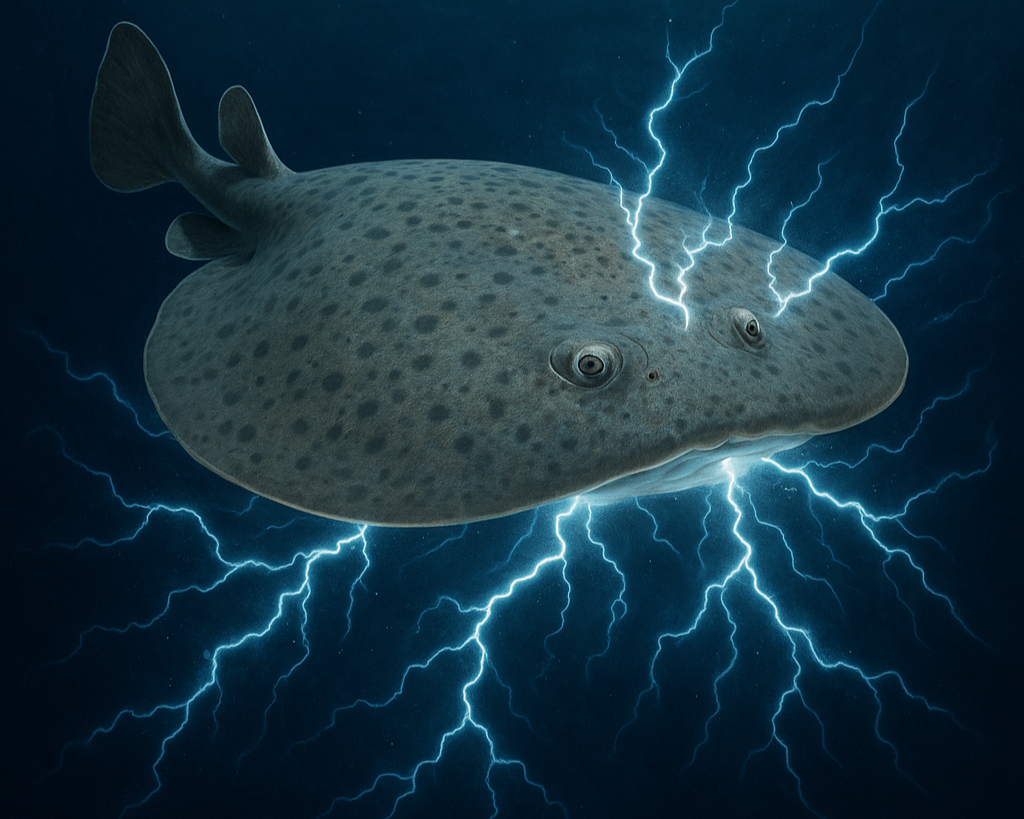
Photo: Created with artificial intelligence
Electric Rays Defend Themselves From Large Sharks Using Electric Discharge
Yannis P. Papastamatiou | Sarah Luongo | Ali Ansaar | Christopher G. Lowe | Mauricio Hoyos-Padilla
Ethology, 131:198–202 (2025)
DOI: https://doi.org/10.1111/eth.70005
Abstract
Marine animals have a variety of traits to protect themselves from predators, including camouflage, toxins, venom, and spines. However, most of these appear ineffective against large animals like some sharks or mammals. Electric rays are able to produce strong electric organ discharges (EODs) that they use to stun and capture prey. Here we use biologging and diver observations to provide evidence that torpedo rays are able to repel large sharks, including white and tiger sharks. Furthermore, we perform in situ measurements of EODs on Pacific electric rays (Tetronarce californica) off the coast of California and show that rays emit longer and more EODs during predatory attempts than they do for defensive purposes. EOD production likely uses anaerobic metabolic pathways, and short duration discharges allow the electric organ to be rapidly reused if a predator returns. Our observations, the lack of electric rays in the diets of large sharks, and the bold behavior of these rays in the wild suggest that EODs may be a highly effective defensive strategy.
Keywords
Anti-predator, biologging, predator-prey